

TRIM ANGLE ADJUSTMENT
To help maintain steering stability and good performance, always maintain the proper trim angle as shown in the illustration. The appropriate trim angle varies depending on the combination of the boat, engine, and propeller, as well as operating conditions.
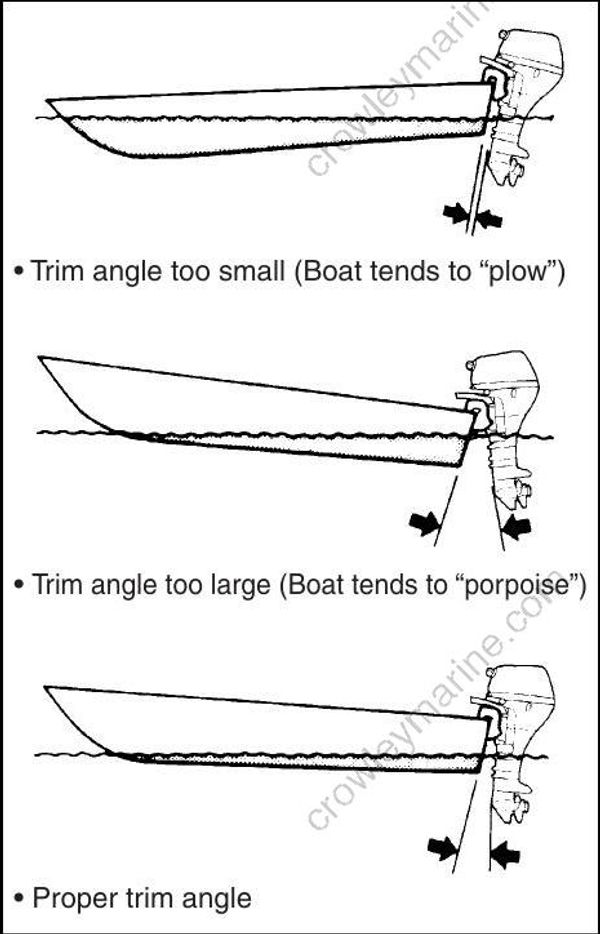
Make a test run in the boat to determine if the trim angle needs to be adjusted. To adjust the trim angle:
Lock the motor in the fully tilted up position.
Reposition the tilt pin A in the desired holes.
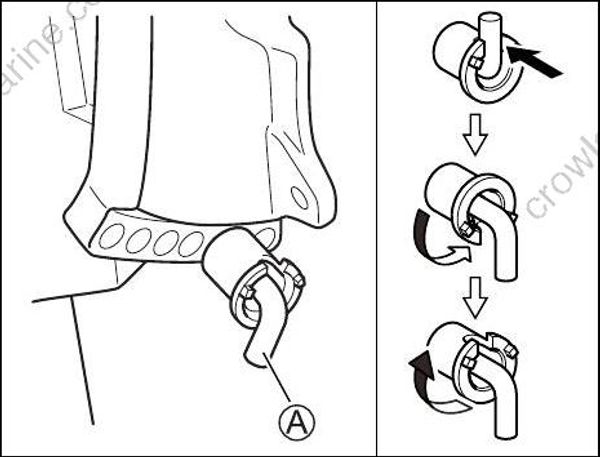
- Lower the motor back down.
To lower the bow, move the pin towards the boat. To raise the bow, move the pin away from the boat.
After you have made an adjustment to the trim angle, make another test run to make sure you have adjusted it to the correct angle.
Trim angle greatly affects steering stability. If the trim angle is too small, the boat may “plow” or “bow steer”. If the trim angle is too large, the boat may “chine walk” from side to side or “porpoise” up and down. These conditions, which result in loss of steering control, can cause occupants to be thrown overboard.
Always maintain proper trim angle based on the combination of your boat, engine, and propeller, as well as operating conditions.
If you operate the motor with the tilt pin removed, you may not be able to control steering as expected.
Do not operate the motor with the tilt pin removed.
STEERING TENSION ADJUSTMENT
The steering on your outboard motor should be smooth and not tight. Adjust the steering tension so that there is only a slight resistance to steering movement.
REMOTE CONTROL MODEL
To increase the steering tension, turn the steering tension bolt (A) clockwise. To decrease the steering tension, turn the steering tension bolt counterclockwise.
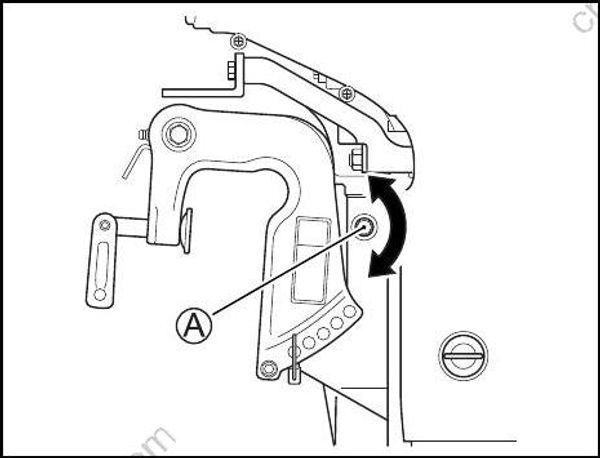
TILLER HANDLE MODEL
To increase the steering tension, turn the steering tension bolt (A) clockwise. To decrease the steering tension, turn the steering tension bolt counterclockwise.
For auxiliary adjustment, use the steering tension lever (B). To increase the steering tension, move the lever (B) to the left. To decrease the
steering tension, move the lever to the right.
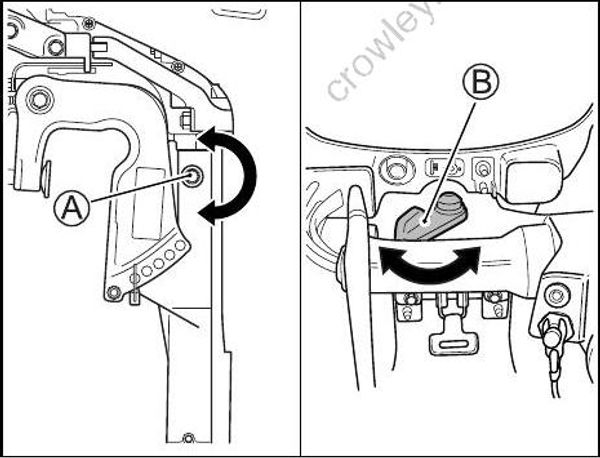
To adjust initial steering friction, use the steering tension bolt (A) with the steering tension lever (B) positioned right fully.
THROTTLE TENSION ADJUSTMENT
TILLER HANDLE MODEL
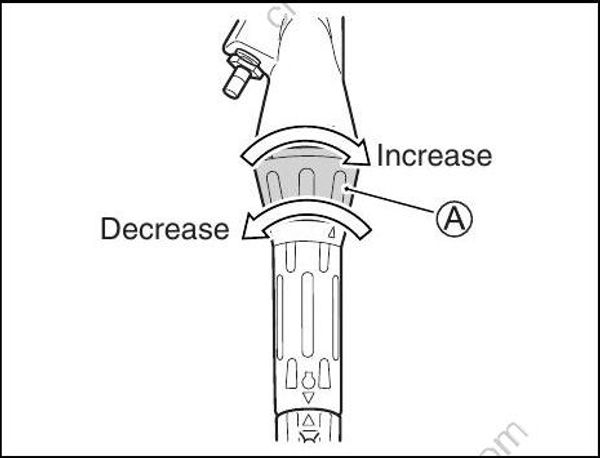
The tension of the throttle control grip can be adjusted according to your preference. To increase the tension, turn the throttle tension adjuster (A) clockwise. To decrease the tension, turn the adjuster counterclockwise.
REMOTE CONTROL MODEL
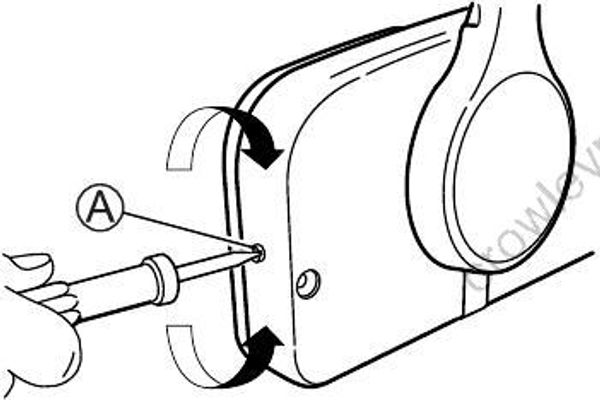
The tension of the remote control handle can be adjusted according to your preference. To increase the tension, turn the throttle tension adjuster (A) clockwise. To decrease the tension, turn the adjuster counterclockwise.
IDLE SPEED ADJUSTMENT
The idle speed of your outboard motor has been set by your dealer. If it is necessary to adjust the idle speed, use the following procedure:
Warm up the engine for about 5 minutes.
Make sure that the motor is in “NEUTRAL” and the throttle control grip is fully closed.
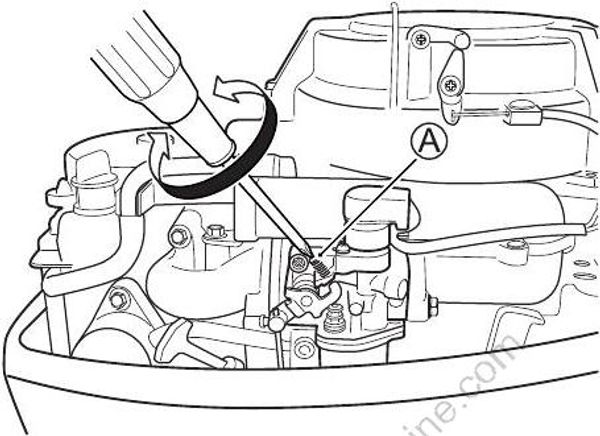
Turn the idle adjustment screw A clockwise to increase idle speed or counterclockwise to decrease idle speed.
| Idle speed (in Neutral) |
900 - 1000 r/min. (min–¹) |
|---|
If idle speed cannot be set within the specified range, contact your authorized Suzuki Marine Dealer.
HIGH ALTITUDE OPERATION OF YOUR OUTBOARD MOTOR
Your outboard motor is equipped with a carburetor that is designed for proper engine operation at various altitudes up to 5000 feet (1500
meters) elevation. If you operate your outboard motor at higher elevations, the change in air pressure may affect the standard carburetor air fuel ratio and could make the engine run too rich. This could decrease engine performance, increase fuel consumption, cause difficult warm starting, and may cause an increase in exhaust gas emissions.
If you always operate your outboard motor at altitudes above 5000 feet (1500 meters), an alternative carburetor jetting specification is available that will adjust the air-fuel ratio to adjust for the change in air pressure resulting from high-altitude operation. These parts are available from Authorized Suzuki Marine Dealers and are designed for correct operation in your motor. If you need to apply these parts to your outboard motor, Suzuki recommends that you have them installed by an Authorized Suzuki Marine Dealer, or a qualified service professional.
If you operate an outboard motor at low altitude (below 5000 feet (1500 meters)) when the engine has been modified for high-altitude operation, the engine could be damaged from overheating, or there could be excessive exhaust gas emissions.
Be sure to reinstall standard-specification jetting in any outboard that has been modified for high-altitude operation prior to operating the outboard at low altitude (below 5000 feet (1500 meters)).