

OVER-REVOLUTION LIMITING SYSTEM
This motor is equipped with a revolution limiting system which activates when engine speed exceeds 6000 r/min.
Over-revolution can result from cavitation when turning hard, a propeller with a slipping bush or worn-down blades, or a trim setting that is too high.
If the over-revolution limiting system activates, the motor will exhibit a rough running condition and you must immediately reduce engine speed to within the recommended operating range.
The Over-Revolution Limiting System will not be activated at recommended maximum throttle unless propeller pitch is insufficient or other factors (like “overtrimming” or “ventilation”) prevail. If the system activates for no apparent reason, you should contact your authorized Suzuki Marine Dealer.
OPERATION OF TILTING SYSTEMS
TILT LOCK
When you shift the motor into “REVERSE” gear, the motor will automatically lock so that it will not lift out of the water due to forces such as propeller thrust.
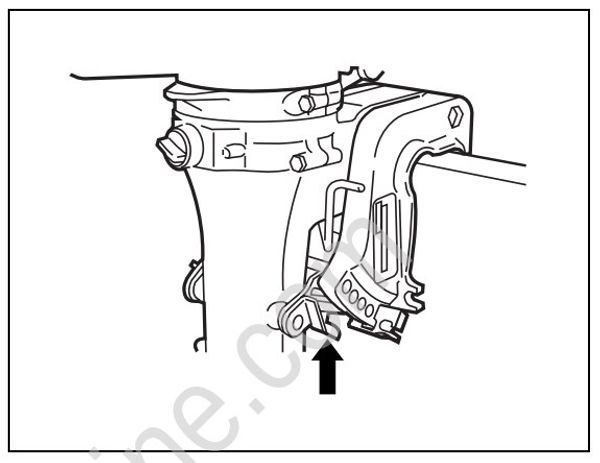
When the shallow water position is used, the tilt lock will not work. Therefore, forces such as propeller thrust during operation in “REVERSE” gear, rapid deceleration, and striking an underwater object can cause the motor to lift out of the water, resulting in personal injury. To avoid such injury, proceed with caution and only at very low speeds when the shallow water position is used.
TILT UP LOCK ARM
The tilt up lock arm is used to hold the motor in the fully tilted up position and shallow water position.
FULL TILT UP POSITION
To hold the motor in the fully raised position:
Never place your hands near the mounting bracket or under the motor when tilting, or they could be crushed if the motor slips from your grasp.
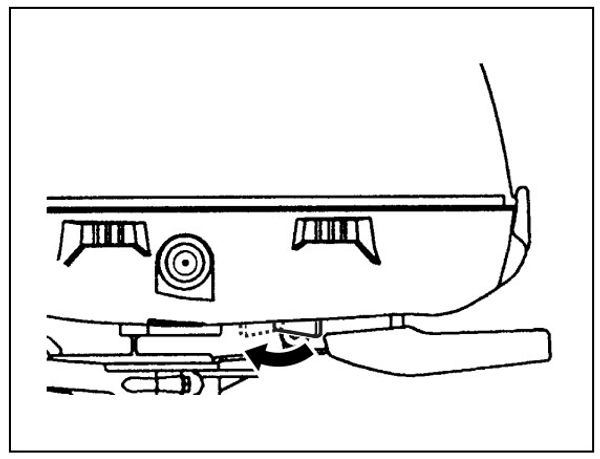
Shift into “NEUTRAL”.
Turn the fuel cock lever to the left (off position) and tighten the air vent screw on the fuel filler cap.
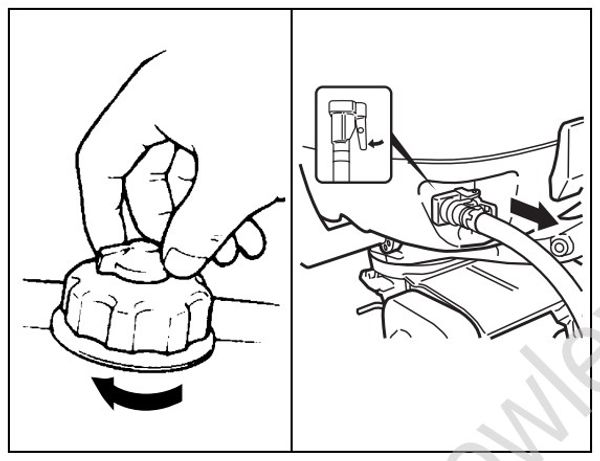
Built-in fuel tank:
Before tilting up the motor, be sure to turn the fuel cock lever to the left and tighten the air-vent screw on the fuel filler cap of built-in tank to prevent fuel from leaking out.
Separate fuel tank:
Disconnect the fuel line whenever you leave the motor tilted up for a long period of time, or fuel may leak out.
- Grab the handle on the back of the motor cover and tilt the motor all the way up until it is automatically locked in the fully tilted up position by the tilt up lock arm (1).
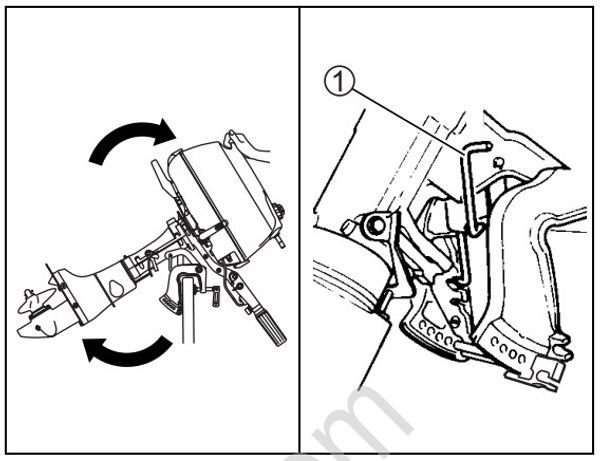
Never use the throttle grip handle to raise or lower the motor. The handle may break.
To lower the motor back down, pull the motor slightly toward you, pull up on the tilt up lock arm (1) and slowly let the motor down.
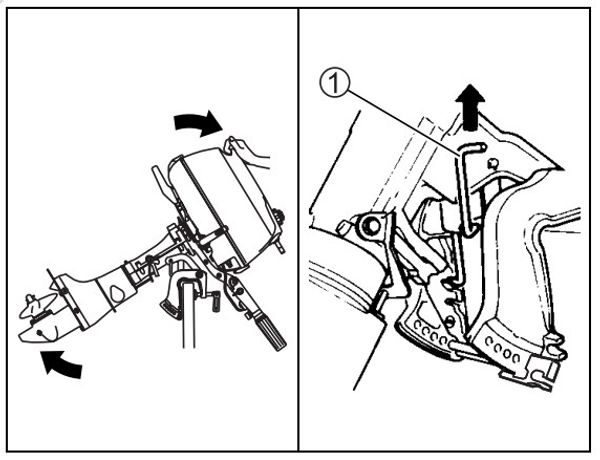
Never use the tilt up lock arm to hold the motor in the fully tilted position for trailering. The tilt up lock arm could release, resulting in damage to the motor.
Alternative power source.
If your outboard motor is used as an alternative power source, make sure that the motor is tilted out of the water and locked whenever it is not being used, or you could damage the motor or boat.
SHALLOW WATER POSITION
To set the motor in the shallow water position:
Shift into “NEUTRAL”.
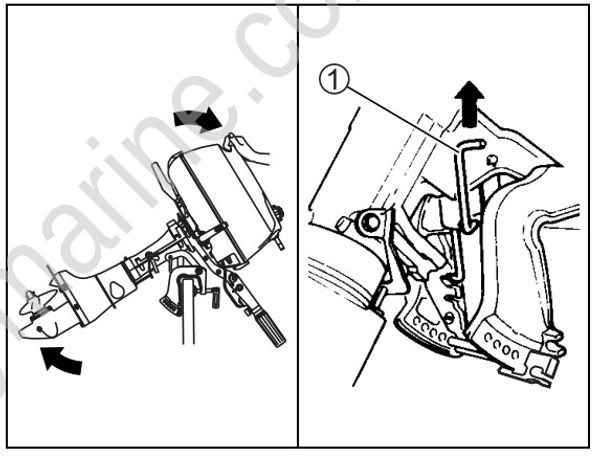
Slowly tilt the motor up until you hear it make a “click” sound.
Slowly lower the motor. It will stop in a position that is slightly tilted up from the normal trim angle.
There are two shallow water positions. Use whichever one is appropriate, depending on the depth of the water. To lower the motor back down, pull the motor slightly toward you, pull up on the tilt up lock arm 1 and slowly let the motor down.
When the shallow water position is used, the tilt lock will not work. Therefore, forces such as propeller thrust during operation in “REVERSE” gear, rapid deceleration, and striking an underwater object can cause the motor to lift out of the water, resulting in personal injury. To avoid such injury, proceed with caution and only at very low speeds when the shallow water position is used.