

MOTOR INSTALLATION
Do not overpower your boat. Never install an outboard motor with horsepower exceeding the manufacturer’s recommended maximum horsepower (listed on the boat “Certification Plate”). Excessive horsepower will have an adverse effect on hull safety and may cause operating/handling difficulties. The boat may also sustain stress and hull damage. It is against federal regulations for any marine dealer to service a motor that exceeds the recommended maxi- mum horsepower for your boat. Contact your authorized Suzuki Marine Dealer if you are unable to locate the hull “Certification Plate”.
Suzuki strongly recommends that you have your outboard motor, controls and gauges installed by your authorized Suzuki Marine Dealer. He has the tools, the facilities and the know-how.
Failure to have your outboard motor and associated controls and gauges properly installed can result in personal injury or damage.
BATTERY INSTALLATION
BATTERY INSTALLATION
BATTERY REQUIREMENT
Choose a 12 Volts cranking-type lead acid battery that meets the specifications shown below.
850 Marine Cranking Amps (MCA)/ABYC,
or 670 Cold Cranking Amps (CCA)/SAE
or 180 Reserve Capacity (RC) Minutes/SAE
• The specifications listed above are the minimum battery rating requirements for starting
the engine.
• Additional electrical loads from the boat will require larger capacity batteries. Consult
your Suzuki dealer to determine the proper battery sizing for your boat and engine combination.
• Dual-purpose (Cranking/Deep-cycle) batteries can be used if they meet the minimum
specifications listed above (MCA, CCA, or RC).
• Do not use a Deep Cycle battery for the main cranking battery.
• The use of Maintenance-Free, sealed, or GelCell batteries is not recommended because
they may not be compatible with Suzuki’s charging system.
• When connecting batteries in parallel, they must be of the same type, capacity, manufacturer, and of similar age. When replacement is necessary, they should be replaced as a set. Consult your Suzuki dealer for proper battery installation information.
BATTERY INSTALLATION
Secure the battery in a dry area of the boat, away from vibration.
• It is recommended that the battery must be installed in an enclosed case.
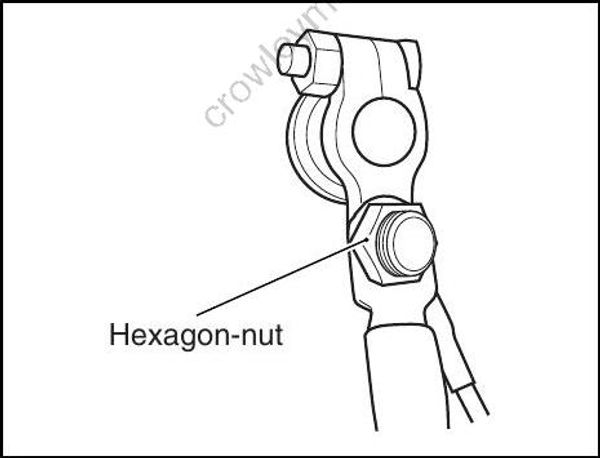
• When connecting batteries, hexagon-nuts must be used to secure battery leads to battery posts.
To hook up the battery, first connect the red lead from the motor to the positive battery terminal, then connect the black lead to the negative battery terminal.
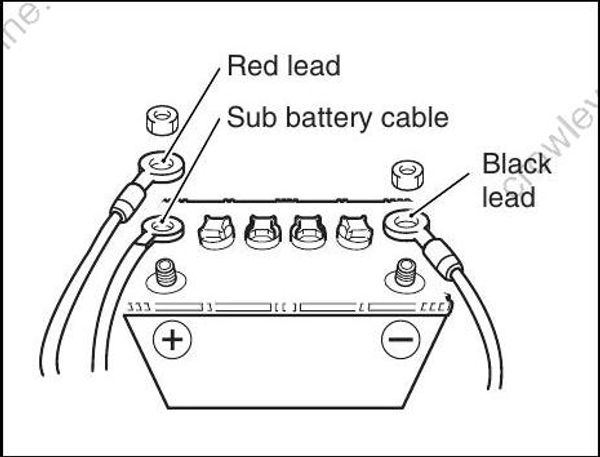
To remove the battery, first disconnect the black lead from the negative terminal, then disconnect the red lead from the positive terminal.
Connecting and disconnecting the battery as described above will help minimize the chance of creating an accidental short circuit and sparks.
• Batteries produce explosive gases. Do not smoke, and keep away from open
flames and sparks.
• Battery acid is poisonous and corrosive. Avoid contact with eyes, skin, clothing, and painted surfaces. If battery acid comes in contact with any of these, flush immediately with large amounts of water. If acid contacts the eyes or skin, get immediate medical attention.
• Do not place the battery near the fuel tank.
• If the battery leads are incorrectly connected, the electrical system could be
damaged.
• Do not disconnect the battery leads from battery while the engine is running. The electrical components could be damaged.
SUB BATTERY CABLE
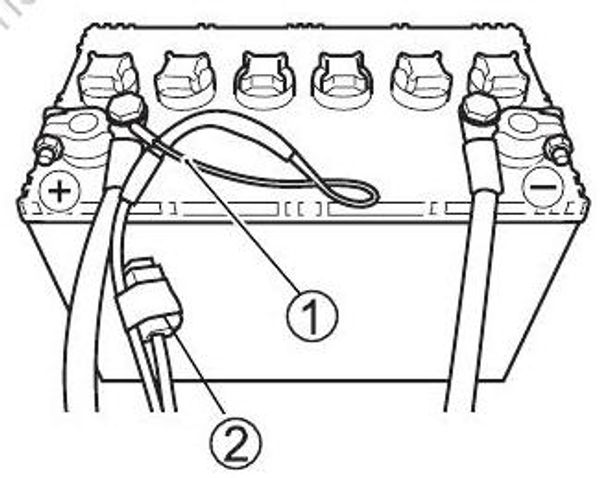
The sub battery cable 1 is used to supply volt age to the engine control system. In the midst of the cable, a 15 A fuse 2 is provided to protect the control circuit.
If the sub battery cable is not correctly connected to the battery, engine cannot be started.
USE OF ELECTRICAL ACCESSORIES
The amount of power (DC12V) available for accessories depends on the operating condition of the motor. For getting a detailed information, please inquire of your authorized Suzuki Marine Dealer.
Use of too much power for electrical accessories under certain operating conditions can cause the battery to dis- charge.
PROPELLER SELECTION AND INSTALLATION
PROPELLER SELECTION
It is essential to use a propeller on your out board motor that is properly matched to your boat’s operating characteristics. The speed of the engine when you operate your boat at full throttle depends on the propeller you use. Excessive engine speed can seriously damage the motor, while low engine speed at full throttle will adversely affect the performance. Your operating load will also affect propeller selection. Smaller loads generally require larger pitch propellers; larger loads generally require smaller-pitch propellers. Your authorized Suzuki Marine Dealer will assist you in selecting a suit able propeller for your boat.
Installing a propeller with pitch either too high or too low will cause incorrect maxi- mum engine speed, which may result in severe damage to the motor.
You can determine if your propeller is appropriate for use with your boat by using a tachometer to measure engine speed when operating your boat at full throttle, under minimum load conditions. If you are using an appropriate propeller, the engine speed will be within the following range:
| DF200 | 5000 – 6000r/min. (min–1) |
|---|---|
| DF225 | 5000 – 6000r/min. (min–1) |
| DF250 | 5500 – 6100r/min. (min–1) |
If the engine speed is not within this range, consult your authorized Suzuki Marine Dealer to determine which propeller size is best for you. If you change propellers, be sure to perform the above check again, to confirm that the engine speed under full throttle is within the specified range.