

Owner's Manual
Check the battery solution level.
The level should be kept between the MAX and the MIN level lines at all times. If the level drops below the MIN level line, refer to MAINTENANCE section.
Make sure that the battery leads are securely connected to the battery terminals.
Visually check the propeller to make sure it is not damaged.
Make sure the motor is securely mounted to the transom.
Make sure the tilt pin is securely installed in the proper position.
Make sure the starter rope is free from any evidence of fraying or wear.
Make sure you have the boating safety and emergency equipment on board.
Make sure that the emergency stop switch operates properly.
Make sure the obstacle is not attached to water intake hole.
BREAK-IN
Proper operation during this break-in period will help ensure maximum lite and performance from your engine. The following guidelines will explain proper break-in procedures.
Failure to follow the break-in procedures described below can result in severe engine damage.
Be sure to follow the engine break-in procedures described below.
Break-in period: 10 hours
Break-in procedure
- For the initial 2 hours:
Allow sufficient idling time (about 5 minutes) for the engine to warm up after cold engine starting.
Running at high speed without sufficient warm-up may cause severe engine damage such as piston seizure.
Always allow sufficient idling time (5 minutes) for the engine to warm-up before running at high speed.
After warming up, run the engine at idling speed or the lowest in-gear speed for about 15 minutes.
During the remaining 1 hour and 45 minutes, if safe boating conditions permit, operate the engine in gear at less than 1/2 (half) throttle (3000 r/min.).
You may throttle up beyond the recommended operating range to plane your boat, then immediately reduce the throttle to the recommended operating range.
For the next 1 hour:
Safe boating conditions permitting, operate the engine in gear at 4000 r/min. or at three-quarter throttle. Avoid running the engine at full throttle.
Remaining 7 hours:
Safe boating conditions permitting, operate the engine in gear at desired engine speed. You may occasionally use full throttle; however do not operate the engine continuously at full throttle for more than 5 minutes at any time.
Running continuously at full throttle for more than 5 minutes at a time during the last 7 hours of break-in operation may cause severe engine damage such as seizure.
During the last 7 hours of break-in operation, do not operate at wide open throttle for more than 5 minutes at a time.
OPERATION
BEFORE ATTEMPTING TO START THE ENGINE
- Lower the motor into the water.
- If there is a manual fuel tank air-vent, turn the air-vent screw (1) on top of the fuel tank cap fully counterclockwise to open the vent.
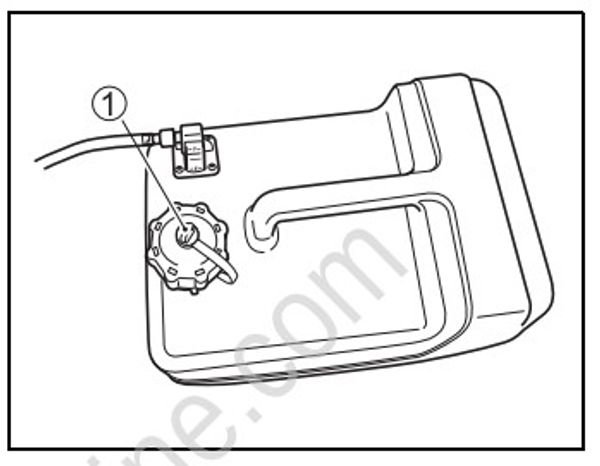
When connecting the fuel hose to the portable fuel tank or motor, the fuel may be under pressure and may spray out around the connector, causing serious injury.
Before connecting the fuel hose, loosen and retighten the fuel tank cap once to relieve the fuel pressure in fuel tank. For handling the fuel tank cap, refer to the “FUEL AND OIL/FILLING FUEL TANK” section in this manual.
SUZUKI genuine portable fuel tanks have a semi-auto air vent.